316L stainless steel eccentric reducers is primarily used to connect pipes of different diameters, allowing for adjustment of channel height or bottom height depending on piping layout. They typically occur in chemical, pharmaceutical and food processing industries, as well as in industrial fluid delivery systems. During installation, in addition to verifying that pipe diameters, wall thicknesses and connection dimensions match, the installation orientation, welding quality, pipe support and the specific characteristics of the transport medium must be considered. As a supplier of stainless steel pipe fittings, we recommend that piping design drawings and operating requirements be reviewed prior to construction to prevent problemssuch as incorrect installation orientation or improper welding from affecting piping system performance.
1.Verifying Pipe Dimensions and Reducer Specifications
Before installing, make sure that the dimensions at both ends of the 316L stainless steel eccentric reducer align are consistent with the connected pipe. Pay particular attention to the connection type at both ends of the nominal diameter, actual outer diameter, wall thickness and size.
The mismatch between pipe and pipe may lead to difficulties in installation, uneven welding gaps or concentration of local stress.
-Ensure that the diameter of both ends of the size conforms to the design specifications.
-Confirm that the wall thickness of the pipe conforms to the design requirements of the pipe.
-Inspection material certifications and product markings for compliance with procurement specifications.
Check fittings any deformation, cracks, visible scratches or other surface defects.
For non-standard or custom-made fittings, acceptance must be based on verified drawings; do not rely solely on visual inspection to determine suitability.
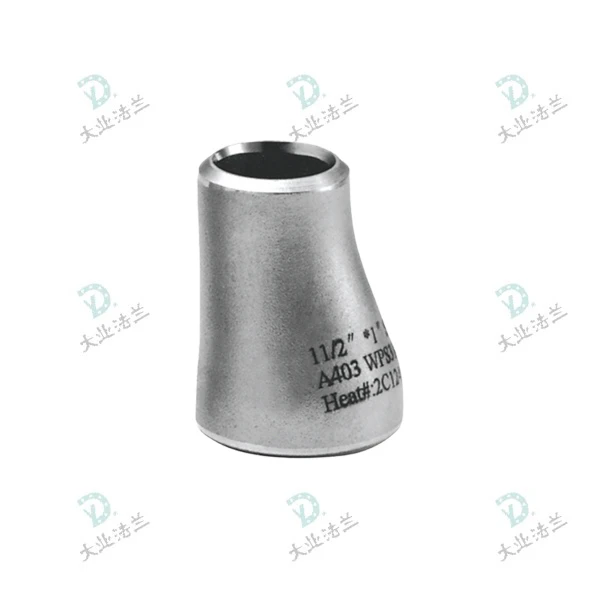
2.Installation Orientation Based on Piping Layout
The main difference between eccentric speed reducers and concentric speed reducers lies their structural geometry. An eccentric reducer has a straight edge and a sloping transition edge, so the orientation of installation directly affects internal flow of the pipe as well as the ventilation and drainage of the pipe.
-Horizontal suction tube: When using an eccentric reducer in pump suction line, the orientation of installationshould be determined in accordance with the piping layout and exhaust requirements, be it the flat edge at the top or the flat edge at the bottom, to minimize the risk of gas accumulation. -Horizontal drainage piping: For pipes requiring complete liquid drainage, the slope of the pipe, the direction of drainage and the location of the low point must be taken into account to determine the direction of installation orientation.
-Vertical piping: direction shall be determined according to the point of connection of the equipment, direction of flow and specific design requirements; installation rules for horizontal piping cannot be applied directly.
Note that "flat-top" or "flat-bottom" configurations is not a general rule that applies to all operating conditions. Specific orientations must be determined in accordance with piping design drawings, pump manufacturer requirements, and system venting and drainage needs.
3. Verify compatibility of 316L material with operating environment
While 316L stainless steel is corrosion resistance-its low carbon content helps reduce the risk of sensitization during welding-it does not protect against all corrosive media.
1. Chemical composition and concentration of the transport medium.
2. Pipeline working temperature and design pressure.
3. The presence of chloride ions, acidic media, or other factors that could cause local corrosion.
4. Whether the material of pipe fittings conforms to the design specification and related material standard.
The risks of pitting, cracking and stress corrosion cracking must be further assessed in environments containing chloride or specific chemicals. For piping for food or pharmaceutical purposes, internal surface finish, cleanliness and hygiene requirements will also need to be verified to meet project standards.
4. Control welding process to prevent pipe damage;
316L stainless steel eccentric reducers is usually connected to the piping system by welding. Because the quality of welding directly affects the connection strength and sealing performance of the pipe, people must adopt welding process suitable for matrix material, wall thickness and joint structure.
-Removal of oil, moisture, rust and other contaminants from the welded grooves and surrounding areas prior to welding.
-Use welding consumables that meet the specific requirements of 316L stainless steel and joints.
-Control welding heat input according to wall thickness and process specification to avoid unnecessary overheating.
-Anti-cleaning (or anti-shielding) of pipes with specific cleaning or corrosion resistance requirements in accordance with established welding procedure. After welding, conduct visual, nondestructive or other specified tests in accordance with the requirements of the project.
Tools dedicated to stainless steel shall be separated from those used for carbon steel to minimize the risk of subsequent corrosion caused by iron contamination. If oxidation discoloration or contamination occurs in the heat affected area after welding, the affected area shall be cleaned and the necessary acidity and passivation shall be carried out in accordance with applicable procedures.
5. Avoid forced installation and Excessive Piping Stress
Do not attempt to force the components into place by pulling, hammering, or tightening if there is a significant dislocation at either end of the pipe during installation.
Forced installation can lead to the deformation of piping components, put additional pressure on welding, and even compromise the long-term reliability of equipment connections and the entire piping system.
_ The big head and the little head are heading in the correct direction.
The coaxial or alignment of the end of the pipe conforms to the design specification.
-Pipeline support is capable of handling a predetermined weight and load.
-Connections to pumps, valves or other equipment are not subject to additional load due to dislocation of piping.
Thermal expansion, vibration and support configuration must also be considered for large pipeline components, high temperature pipelines or systems subject to significant vibration.
1. Can a 316L stainless steel eccentric reducers be installed horizontally?
Yes. ' When installing horizontally, the flat roof or bottom orientation shall be selected according to fluid flow direction, equipment requirements, and ventilation or drainage needs.
2. Does the 316L stainless steel eccentric reducers require pickling and passivation after welding?
The necessity for this treatment depends on the surface conditions after welding, the corrosivity of the processing medium and project specifications. validated cleaning and surface treatment processes must be applied to piping systems with specific corrosion resistance or hygiene requirements.
3. Can 316L stainless steel eccentric reducers be used in the suction piping of the pump? It can be applied to the suction pipelines of some pumps, but configuration and installation orientation must be determined according to the pump's inlet size, flow velocity, risk of gas accumulation and manufacturer requirements. In addition, care should be taken to avoid improper piping layouts, so as not to increase suction losses.